The kings' necropolis
Beyond the free nave, the transept, chevet and crypt hold more than 70 recumbent effigies and tombs of the kings and queens of France. Here is what you are looking at, tomb by tomb.
The effigies and the Renaissance tombs are spread through the transept and chevet; the crypt lies beneath them, down a flight of stairs.
-
The gisants
Effigies of the earliest kings
Recumbent stone figures carved lying in prayer, eyes open. Louis IX had sixteen made in the 13th century to honour earlier kings already buried here, centuries after their deaths; fourteen of them survive in the transept.
-
Louis XII & Anne of Brittany
A marble temple for a king who died in 1515
The royal couple appear twice: kneeling in prayer on the roof, and, below, carved as naked, lifeless figures, a Renaissance meditation on death set beside majesty.
-
François I & Claude de France
A mid-16th-century monument
One of the three grand Renaissance tombs built on the same plan: the bodies of the king and queen below, the same couple kneeling in prayer above.
-
Henri II & Catherine de' Medici
A temple tomb designed by Primaticcio
Modelled on a Roman temple, with the king and queen in prayer on the roof, it is among the most ambitious funerary monuments the French Renaissance produced.
-
The crypt
Louis XVI & Marie-Antoinette
Their remains were found in January 1815 and brought to Saint-Denis after the Restoration; the plain black-marble slabs that mark them in the crypt today were installed in 1975, and Louis XVIII was laid nearby in 1824.
-
The ossuary
Bones gathered after 1793
When revolutionary crowds opened the royal tombs in 1793, the bodies were thrown into trenches. In 1817 the remains of 158 people were gathered into an ossuary in the crypt, behind marble plates bearing their names.
What a visit actually involves
Where Gothic architecture began
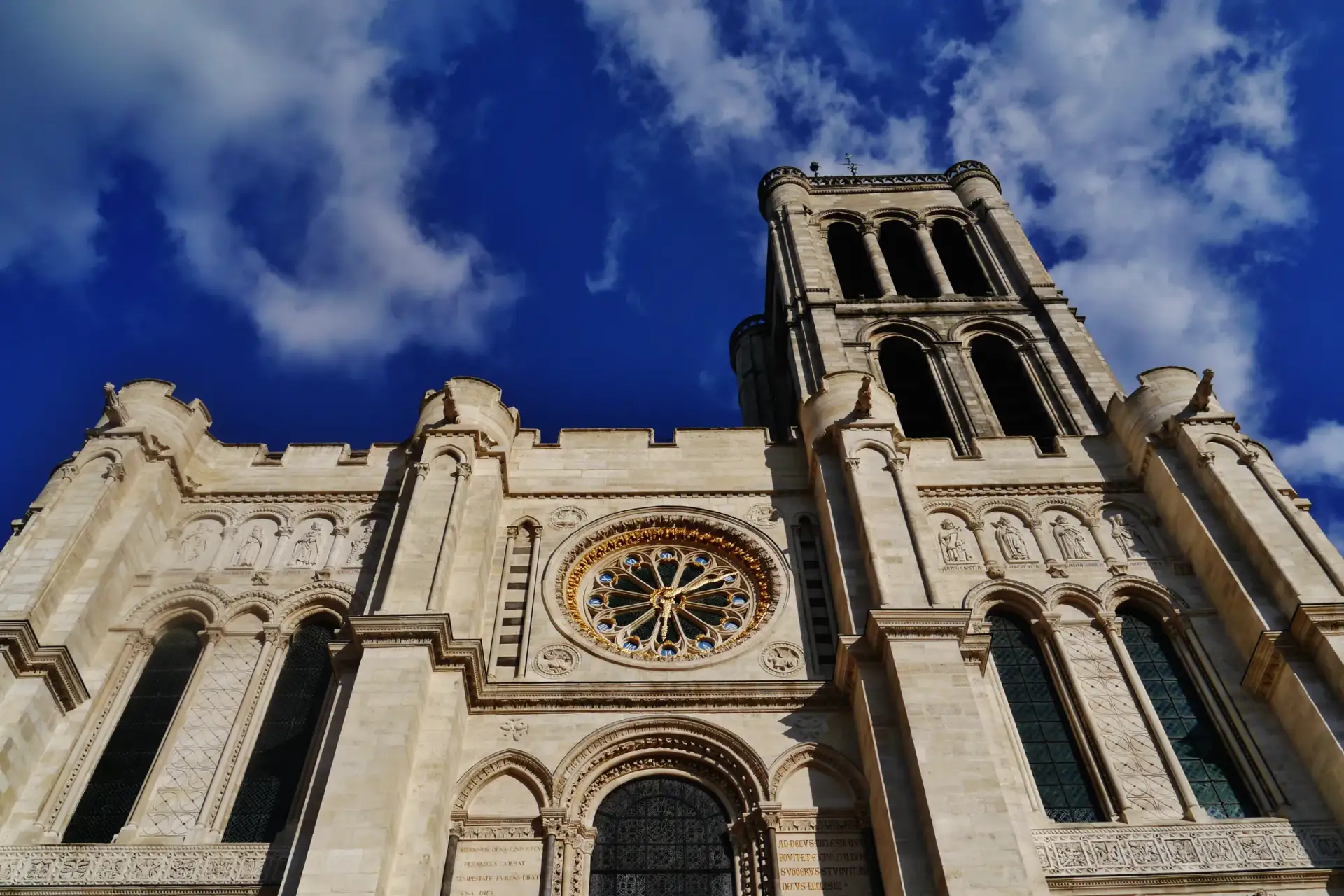
Around 1140, Abbot Suger rebuilt the east end of the abbey church with ribbed vaults, pointed arches and a ring of chapels opened up with stained glass. Dedicated on 11 June 1144, it is widely regarded as the first building to bring these elements together as Gothic architecture, a style that spread from here across northern France and beyond.
A necropolis of kings and queens
Saint-Denis became the burial place of the kings of France: by the monument's own count, 40 kings and 26 queens, along with princes, princesses and servants of the crown, from Dagobert in 639 to Louis XVIII in 1824. More than 70 recumbent effigies and tombs fill the transept and chevet, from medieval figures carved lying in prayer to the taller Renaissance tombs that followed them.
The nave is free; the necropolis is not
The basilica's nave remains part of a working cathedral and can be visited without a ticket. The royal tombs in the transept, the chevet with its ambulatory, and the crypt form the royal necropolis, the part of the monument that requires an entrance ticket, which also covers the spire workshop.
A spire being rebuilt by hand
Outside, the basilica's north tower and spire, taken down in 1846–47 after storm damage, are being rebuilt; the foundation stone was laid on 14 March 2025 for a project expected to take about five years. A visitable workshop at the foot of the building, the Fabrique de la flèche, opened in October 2025, so visitors can watch the stonework in progress. It is closed on Mondays.
The Fabrique de la flèche, the spire workshop, is closed on Mondays, when only the royal necropolis is open, and the necropolis itself closes at times for services.
Guides to the necropolis
Timing
The best time to visit Saint-Denis
Which days are quiet, how the seasons change the hours, and why Mondays are different.
Open this guide →Getting there
How to get to the Basilica of Saint-Denis from Paris
The Métro stop 100 metres from the door, plus the RER and tram alternatives.
Open this guide →The tombs
A guide to the royal tombs of Saint-Denis
Who is actually buried here, how to read the medieval effigies, and what the Renaissance tombs are showing you.
Open this guide →Inside
What to see in the royal necropolis of Saint-Denis
A walking order for the choir, the tombs, the crypt and the spire workshop.
Open this guide →Nearby
Saint-Denis and the Panthéon: two resting places, two Frances
The royal necropolis north of the city and the Republic's mausoleum in the Latin Quarter, and how they compare.
Open this guide →Questions about visiting
Is this the Centre des monuments nationaux's own site?
No. This is an independent guide to visiting the Royal Necropolis, researched and written separately from the monument. Its own website is saint-denis-basilique.fr.
What's the difference between the nave and the Royal Necropolis?
The nave is the part of the working cathedral that anyone can enter without a ticket. The royal necropolis, with the royal tombs in the transept, the chevet with its ambulatory and the crypt, lies beyond it and requires an entrance ticket.
Who is buried at Saint-Denis?
By the monument's own count, 40 kings and 26 queens of France, plus around 60 princes and princesses and a dozen servants of the crown, from Dagobert in 639 to Louis XVIII in 1824. Louis XVI and Marie-Antoinette lie in the crypt. Many of the bodies were thrown into trenches in 1793, so for much of the line the effigies survive where the remains do not.
Why is Saint-Denis called the birthplace of Gothic architecture?
Around 1140, Abbot Suger rebuilt the east end of the church using ribbed vaults, pointed arches and large stained-glass windows together in a way historians regard as the first Gothic design. It was dedicated in 1144, and the style spread from here across northern France and beyond.
Is the spire actually being rebuilt right now?
Yes. The north tower and spire, taken down in 1846–47 after storm damage, are being rebuilt in a project whose foundation stone was laid in March 2025 and which is expected to take about five years. A visitable workshop at the foot of the building, the Fabrique de la flèche, opened in October 2025 and is closed on Mondays.
How do I get to Saint-Denis from central Paris?
Métro line 13 to Basilique de Saint-Denis station, about 100 metres from the door and roughly 20 to 25 minutes from the centre of the city. That station has no lift; the alternative is the RER D to Saint-Denis, then tram T1 or a 15-minute walk.
How long should I allow for a visit?
Most visitors allow around an hour to ninety minutes for the choir, the royal tombs, the crypt and the spire workshop, moving through at their own pace.
Does anyone get in without paying?
Under the monument's own rules, visitors under 18 are admitted to the royal necropolis without charge, as are 18-to-25-year-olds who are European Union nationals or long-term non-EU residents of France, on proof of identity. Group visits are excluded from both.